A Life Shaped by Medicine, Service, and Motion
I think Walter Pettus Dey was the kind of man who seemed built for more than one world. He was born on June 22, 1881, in Dallas, Texas, and lived a life that moved across medicine, military service, diplomacy, and family legacy. His story has the texture of an old map, with routes stretching from the American South to the Far East, and with each path leaving a mark on the people around him.
I see him first as a physician. He studied at the University of Alabama and earned a medical degree from Tulane University Medical School in 1909. That detail matters because it places him in the serious, disciplined world of early 20th century medicine, when a doctor’s work demanded long hours, sharp judgment, and a steady hand. He later became a surgeon, and his professional identity seems to have widened rather than narrowed over time. He was not only a doctor in the ordinary sense. He was also a Navy captain, a military man, and, according to family accounts, a medical inspector connected with overseas work in the Far East under Franklin Roosevelt.
That combination gives him a fascinating shape. He was a man in a white coat and a uniform. He was at once clinical and worldly. The image I carry is of someone who could move from the precision of surgery to the larger chessboard of international service without losing his bearing.
The Dey Family Line
Walter’s family background rooted him in an older Southern line. His father was Gen. Francis Edgar Dey, often called Frank Dey, and his mother was Carolyne Malvina Day Dey. The family tree around him was large and layered, with several siblings who formed the domestic world he came from.
His siblings were William Edgar Dey, Carolyn H. Dey, John Henry Dey, often called Harry, Edith Virginia Dey, Reddick Marion Dey, and Jessica Louise Dey. That is a full house by any measure. I imagine a family where reputation, inheritance, and identity mattered deeply, and where the Dey name carried the weight of history from one generation to the next.
Francis Dey, Walter’s father, belonged to the older Southern military tradition, and that helps explain part of Walter’s own public shape. In families like this, duty often appears less as a choice and more as a current running under the floorboards. Walter seems to have inherited that current and carried it into medicine and naval life.
Frances Pearl Sudler Wilkinson Dey
Walter’s wife was Frances Pearl Sudler Wilkinson Dey, and she appears to have been a striking counterpoint to him. Patricia Altschul described her mother as a cultivated Northern woman, with Philadelphia roots and a temperament shaped by a very different region and social atmosphere. That mix of Southern and Northern lineage creates a family story with contrast in its bones.
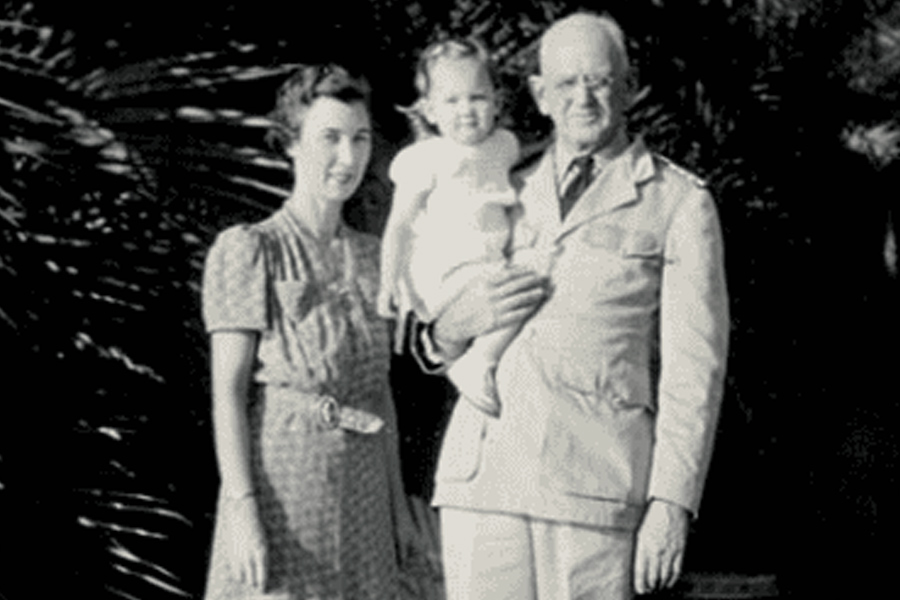
Walter married Frances later in life, when he was 58 and she was 30. Those numbers say a lot. They suggest a marriage formed across generations, experience, and temperament. I picture Frances as a woman who brought polish, restraint, and a different kind of elegance into Walter’s world. Together, they formed the center of the next generation.
Their marriage produced one especially well known child, Patricia Madelyn Dey Altschul. Through Patricia, Walter’s family line became visible to a much wider public. He was no longer just a private patriarch inside a family album. He became part of a larger social story.
Patricia Altschul and the Father Daughter Bond
Patricia Altschul is Walter Pettus Dey’s most famous descendant and a link between his time and ours. Her 1941 birth, career as an art dealer, collector, socialite, and TV personality made her family background more public. Walter became a parent and formative figure via her.
One of his most memorable scenes is Walter and Patricia’s relationship. Patricia wrote with love and admiration, painting an intimate image. His family name was familiar. He guided, told stories, and accompanied. He frequented her after retirement and shared his stories. Her place was taken. She heard his tales. He broadened horizons.
Family impact is frequently subtle, so that matters. This adds up. It is a voice, habit, or phrase repeated at the perfect time. Patricia’s calm, worn mind seems to have been influenced by Walter. His travels, discipline, and history helped her grasp Southern identity and society.
Work, Travel, and Achievement
Walter’s professional life seems to have been built on movement and responsibility. Medicine gave him a calling. The Navy gave him rank and structure. Diplomacy and overseas inspection work gave him reach. He was not confined to a single stage. He moved through several, like a man crossing rooms in a large house and carrying different keys in each pocket.
His achievements are best understood in layers. First, there is the formal training. A medical degree is a serious achievement in any era, and in 1909 it signaled real commitment and rigor. Second, there is his military service. Being a Navy captain was no small thing. It marked him as a man trusted with command and responsibility. Third, there is the broader arc of his career, which included work connected to the Far East and the kind of travel that would have been rare, even glamorous, in that period.
Patricia’s recollections also give him a globe-spanning dimension. She described him as having traveled in China and Japan and as having lived a life touched by foreign assignments. That detail gives his biography a cinematic sheen. He was not merely a domestic professional. He was a man with stories that likely carried the scent of ocean air, hospital corridors, military discipline, and distant ports.
A Timeline of Walter Pettus Dey
In Dallas, Texas, Walter Pettus Dey was born on June 22, 1881. Tulane University Medical School awarded him a medical degree in 1909. Over time, he became a doctor and surgeon. He is listed as a Jacksonville, Florida, U.S. Navy officer during World War I. He became a captain, global traveler, and abroad medical inspector, according to family accounts.
Marriage to Frances Pearl Sudler Wilkinson occurred around 1939. Daughter Patricia was born in Jacksonville in 1941. Patricia remembered Walter as a symbol of love, storytelling, and influence. He died at 77 on April 14, 1959.
Walter in the Family Memory
Walter’s importance is not only that he lived a varied life. It is that he became a hinge between generations. He linked an older Southern military family, a medically trained professional life, a wife with Northern refinement, a daughter who became a public personality, and a grandson, Whitney Sudler-Smith, who continued the family’s visibility into a new era.
That is a remarkable kind of legacy. Some people leave behind buildings, papers, or institutions. Walter left behind a family narrative. His life still moves through later generations like a current under polished stone.
FAQ
Who was Walter Pettus Dey?
Walter Pettus Dey was a physician, surgeon, Navy officer, and family patriarch born in 1881 in Dallas, Texas. He later became known as the father of Patricia Altschul and the grandfather of Whitney Sudler-Smith.
Who were Walter Pettus Dey’s parents?
His parents were Gen. Francis Edgar Dey and Carolyne Malvina Day Dey.
Did Walter Pettus Dey have siblings?
Yes. His siblings included William Edgar Dey, Carolyn H. Dey, John Henry Dey, Edith Virginia Dey, Reddick Marion Dey, and Jessica Louise Dey.
Who was Walter Pettus Dey’s wife?
He married Frances Pearl Sudler Wilkinson Dey. She is remembered as Patricia Altschul’s mother.
Was Walter Pettus Dey the father of Patricia Altschul?
Yes. Patricia Altschul was his daughter, and she later became the best known public figure connected to him.
How is Walter Pettus Dey connected to Whitney Sudler-Smith?
Walter Pettus Dey was Whitney Sudler-Smith’s grandfather through Patricia Altschul.
What was Walter Pettus Dey’s profession?
He was a physician and surgeon, and he also served in the U.S. Navy. Family accounts describe him as a captain and a medical inspector with overseas responsibilities.
When did Walter Pettus Dey die?
He died on April 14, 1959, at the age of 77.