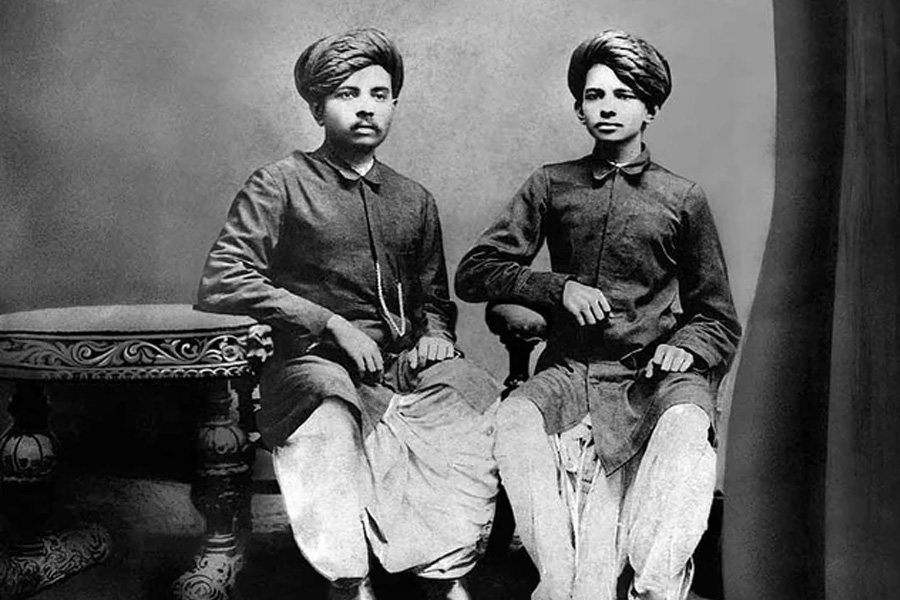
A brief portrait
Laxmidas Karamchand Gandhi appears in the margins of larger histories, a figure traced mainly through photographs, family lists, and the achievements of descendants. Born around 1860 and recorded as dying in 1914, he lived through a pivotal half-century in western India: an era of princely courts, colonial administration, and social change. He was a son, a brother, a husband, and a father — roles that stitched him into the Gandhi family tapestry even if few public documents record his own voice. The following is a compact, date-rich sketch of that life and the family branches that connect him to events both ordinary and historic.
Basic information
| Field | Detail |
|---|---|
| Full name | Laxmidas Karamchand Gandhi |
| Approximate birth year | c. 1860 |
| Death year | 1914 |
| Father | Karamchand Uttamchand Gandhi (b. 1822) |
| Mother | Putlibai Gandhi (b. 1844) |
| Notable sibling | Mohandas Karamchand Gandhi (b. 2 Oct 1869) |
| Spouse | Nandkunwar (name appears in genealogies) |
| Known child | Samaldas Gandhi (b. 1897 — d. 1953) |
| Public prominence | Family member; limited individual public record |
Family constellation: names and numbers
Laxmidas belonged to a family that contained both local administrators and, later, a national icon. Numbers help: at least two generations above him (grandparents), two parents, multiple siblings and children. Below is a compact table of immediate family members commonly attributed to him.
| Relation | Name | Years (when known) |
|---|---|---|
| Father | Karamchand Uttamchand Gandhi | 1822–1885 |
| Mother | Putlibai Gandhi | 1844–1891 |
| Older sister | Raliatbehn Gandhi | (birth year inferred c.1862) |
| Older brother | Karsandas Gandhi | (dates not consistently recorded) |
| Younger brother | Mohandas Karamchand Gandhi | 2 Oct 1869 – 30 Jan 1948 |
| Spouse | Nandkunwar Gandhi | (dates not recorded) |
| Son | Samaldas Gandhi | 1897–1953 |
| Grandparents (paternal) | Uttamchand & Laxmiba Gandhi | (19th-century figures) |
Timeline of key dates and events
| Year / Date | Event |
|---|---|
| c. 1860 | Birth of Laxmidas Karamchand Gandhi (approximate). |
| 1862 (approx.) | Birth of sister Raliatbehn (inferred from family records). |
| 2 Oct 1869 | Birth of Mohandas Karamchand Gandhi, Laxmidas’s younger brother. |
| 1880s–1890s | Family portraits and formal photographs show Laxmidas among siblings. |
| 1897 | Birth of son Samaldas Gandhi. |
| 1914 | Death of Laxmidas Karamchand Gandhi (recorded in photo captions). |
| 1947 | Samaldas Gandhi leads the Provisional Government of Junagadh following partition. |
| 1953 | Death of Samaldas Gandhi. |
The private life that public records omit
The record often names Laxmidas but rarely narrates his inner life. There are at least three reasons for the relative silence. First, the archival spotlight in national histories fell elsewhere — notably on Mohandas Karamchand Gandhi. Second, the administrative culture of the time left many provincial figures poorly documented unless they held formal office or produced published works. Third, family histories and genealogies, while rich in names, frequently omit precise dates, occupational titles, and personal letters.
What survives are photographs, captions, and later family recollections. These visual traces — portraits from the 1880s and 1890s — place Laxmidas in a sartorial and social world of collars, turbans, and formal studio poses. They show him standing in relation to brothers and parents: positioned, literally and metaphorically, within a household that would later resonate with national significance.
Career notes and financial standing: a sparse ledger
Public documentation does not present a ledger of offices, honors, or published works for Laxmidas. A few genealogical accounts refer to him as having worked in some form of government service. The description is cautious: terms like “government servant” or “employed in local administration” appear without archival references or job titles. No verified record of a high civil post or of major public initiatives is available in mainstream records tied to his name. Financial status likewise remains unrecorded in accessible public sources; any estimate would be speculative.
Children and descendants: the most visible branch
Numbers matter again when tracing legacy. Laxmidas fathered at least one son whose life entered public notice: Samaldas Gandhi (1897–1953). Samaldas became a journalist and political actor; notably, he played a role in the Junagadh episode of 1947, heading a provisional administration during the region’s disputed accession. That single datum draws a direct line from the quieter life of Laxmidas to a decisive moment in modern India’s partition and princely-state negotiations.
Other children and family branches are listed in genealogies — names like Jadavbehn and Ranchhoddas appear — but their public footprints are smaller. The family map therefore widens in some directions and fades in others.
The camera as witness
Photographs function like fingerprints for this family. Several images — studio portraits and family group shots — carry captions that anchor Laxmidas’s approximate birth and death years: 1860–1914. These visual records give shape to a life otherwise thin on documentary prose. In one image he stands beside his better-known brother; in another, the family tree spreads like shadowed branches. The camera gives him a face and a place; official records give him a footnote.
Personality and presence — inferred, not recorded
Because direct testimony (diaries, letters, published speeches) is scarce, personality must be inferred from placement in the family, the era’s cultural norms, and the careers of relatives. He was, by family position, an elder brother to Mohandas, and a father to Samaldas. He inhabited the household structure of a late 19th-century Gujarati family: extended, hierarchical, steeped in local office and traditional duty. His life likely moved between household responsibilities, local social obligations, and whatever administrative or occupational role he occupied.
Metaphorically, Laxmidas reads like a supporting beam in an old house: not the carved mantel or the carved stair, but the timber that holds the structure upright. The house, in this case, became historically notable because one interior room — the one occupied later by Mohandas — opened onto the world.
Why the gaps matter
Gaps in documentation are not empty voids; they are shapes that move scholarship and family curiosity. They invite questions about class mobility, record-keeping practices in princely states, and the ways memory preserves some names while letting others recede. They also underscore how family networks transmit influence across generations: a relatively obscure brother can be the parent of an active political actor in the next generation.
A mapped family (compact table)
| Generation | Notable names | Remarks |
|---|---|---|
| Grandparents (paternal) | Uttamchand & Laxmiba Gandhi | The family root in the 19th century. |
| Parents | Karamchand Uttamchand Gandhi (1822–1885) & Putlibai Gandhi (1844–1891) | Karamchand served as Diwan in regional courts. |
| Siblings | Raliatbehn; Karsandas; Mohandas (b. 1869) | Mohandas is the internationally known figure. |
| Children (of Laxmidas) | Samaldas (1897–1953); possibly others | Samaldas is a public-facing descendant. |
Final note on sources of certainty
Some details — exact birth year, occupational titles, lists of every child — remain approximate. The firm dates are those recorded across family captions and public records: 1860 (approx.), 2 October 1869, 1897, 1914, 1947, 1953. Beyond those anchors, the portrait is built from photographs, family registers, and the one branch of public activity that emerges in a descendant. The portrait is deliberate in its restraint, because to fabricate certainty where archives are silent would be to misread the skeleton of a life.