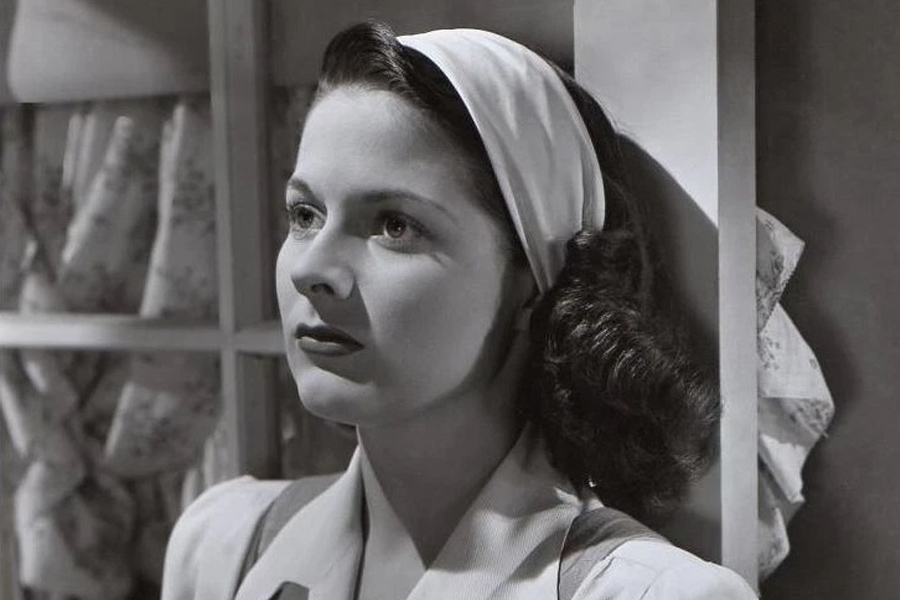
Jo Carroll Dennison lived a life that seemed to contain several different eras of American history. Born on December 16, 1923, in Florence, Arizona, she grew up on a traveling medicine show, became Miss America in 1942, entered Hollywood during its Golden Age, worked in television production, raised two sons, served hospice patients, and published her memoir at the age of 97. Her story was not simply about beauty or fame. It was about independence, reinvention, family, courage, and the search for a meaningful life after the spotlight faded.
She died on October 18, 2021, at her home in the Idyllwild-Pine Cove area of California, aged 97. By then, she was the oldest living former Miss America. Yet her later years were in many ways more revealing than her years of celebrity.
Jo Carroll Dennison Early Life on the Road
Jo Carroll Dennison was born into an unusual family. Her father, Harry Arthur Dennison, operated a traveling medicine show and vaudeville style troupe that moved through communities across the American West and Texas. Her mother, Elizabeth Brownd Dennison, helped hold together a family whose existence was shaped by constant travel and financial uncertainty.
Dennison’s birthplace was especially unusual. She was born in the infirmary of a men’s state prison in Florence, Arizona. Her parents were traveling when Elizabeth went into labor, and the prison doctor happened to be the available medical help. Her father had reportedly hoped that his daughter would be born in California, but circumstances decided otherwise.
Her childhood was spent around performers, entertainers, animals, crowds, and temporary stages. She learned to sing and dance at a young age and eventually taught herself trick riding on horseback. School was interrupted repeatedly by the family’s travels, giving her an education that was as much practical as academic.
In 1940, she graduated from Hale Center High School in Texas. She later worked as a stenographer and secretary in Tyler, Texas, including a position connected with a former governor.
Behind the glamorous photographs that would eventually make her famous was a young woman who had already learned how to adapt. Her childhood gave her an instinct for survival that remained visible throughout her life.
The Road to Miss America in 1942
Dennison did not initially dream of becoming a beauty queen. In 1942, a local banker in Tyler encouraged her to enter the Miss Tyler contest. She was reportedly reluctant, but the promise of a free swimsuit helped persuade her.
The decision changed the course of her life.
She won Miss Tyler, followed by Miss East Texas and then Miss Texas. On September 12, 1942, in Atlantic City, New Jersey, the 18 year old Dennison was crowned Miss America. She became the first Miss Texas to win the national title and earned the nickname “Texas Tornado.”
Her winning program included talent, evening gown, and swimsuit competition. She performed “Deep in the Heart of Texas,” bringing a distinctly Texan identity to the national stage.
The timing was extraordinary. The United States had entered World War II only months earlier, and Dennison became the first Miss America crowned during the wartime period following America’s entry into the conflict.
Her title quickly became more than a crown.
Jo Carroll Dennison as a Wartime Symbol
During her year as Miss America, Dennison traveled extensively. She visited defense plants, hospitals, military camps, and other wartime facilities. She sold war bonds and entertained members of the armed forces.
Her photographs also turned her into a celebrated wartime pin-up. Images published in Life magazine helped make her particularly popular among American servicemen. She was reportedly second only to Betty Grable in popularity among GIs.
Yet Dennison did not always embrace the way her appearance was used.
One of the most interesting parts of her legacy is her early resistance to the swimsuit requirement. Although she had competed in a swimsuit to win the crown, she later refused to wear one at many appearances during her reign. She believed that being repeatedly displayed in a bathing suit reduced her to her body when she wanted audiences to recognize her voice, intelligence, and personality.
Decades later, her position became part of the larger history of the Miss America swimsuit controversy. When the organization eliminated the swimsuit competition in 2018, Dennison supported the change.
Her attitude was striking because it appeared long before many of the better known public challenges to pageant culture. In that sense, her resistance was a quiet crack in a very old wall.
Hollywood and the Golden Age
After her Miss America reign, Dennison entered Hollywood. In November 1942, 20th Century Fox signed her to a seven year contract, with an initial salary reported at approximately $100 a week.
She appeared in a series of films during the 1940s and early 1950s. Her credits included The Song of Bernadette, The Gang’s All Here, Something for the Boys, Winged Victory, State Fair, The Missing Lady, The Jolson Story, Beyond the Purple Hills, and Prehistoric Women.
Her film career never transformed her into a major leading star, but Hollywood opened another world to her.
She also worked in television, appearing in programs such as Dick Tracy, The Abbott and Costello Show, Adventures of Kit Carson, and Lux Video Theater. She later moved behind the camera, becoming involved with television production and live broadcasting.
This shift was important. Dennison was not content to remain in front of the camera. Production gave her another way to participate in the rapidly developing world of television.
Her Marriage to Phil Silvers
In Hollywood, Dennison met comedian and actor Phil Silvers while working on Something for the Boys. The two married on March 2, 1945, in Los Angeles.
Silvers was already a prominent entertainer and would later become famous as Sergeant Bilko. Their marriage connected Dennison to a lively circle of Hollywood performers, musicians, writers, and intellectuals.
She attended gatherings where figures such as Gene Kelly, André Previn, and Paul Robeson could appear alongside entertainers and artists. She also encountered stars including Frank Sinatra, Bing Crosby, and Danny Kaye.
Dennison later remembered the marriage with a mixture of affection and realism. She described marrying Silvers “for laughter,” a phrase that captures both the romance and the impulsiveness of the relationship.
The marriage lasted until March 8, 1950. They had no children.
Gambling and differences in lifestyle contributed to the breakdown of the marriage. Despite the divorce, they remained friendly. Silvers reportedly remained close to Dennison’s mother, demonstrating that family connections sometimes survive even when marriages do not.
Her Marriage to Russell C Stoneham
Dennison wed director and television producer Russell C. Stoneham on October 17, 1954. Stoneham contributed to shows like Barnaby Jones, The Streets of San Francisco, and Playhouse 90.
A new type of family life was brought about by this union. Peter and John Stoneham are the sons of Dennison and Stoneham.
They were said to have very different personalities and political philosophies. Stoneham was characterized as more pragmatic and conservative, whereas Dennison was more liberal and free-spirited. In the late 1970s, their relationship deteriorated to the point of separation.
On April 13, 1981, their divorce was officially formalized.
The evolution of concepts pertaining to the relationship at the core of Arthur Laurents’ The Way We Were has also been linked to the marriage. In Dennison’s own life, the conflict between individual autonomy and societal norms became a recurrent issue.
Jo Carroll Dennison and Her Sons
Dennison’s two sons, Peter Stoneham and John Stoneham, were among the most important members of her later family life.
Unlike their mother, Peter and John largely remained outside the public spotlight. Their childhood unfolded away from the intense attention that had followed Dennison since her Miss America victory.
Peter later confirmed his mother’s death to the media. Dennison was also survived by three grandchildren.
The limited public information about her sons is itself meaningful. Their lives were not built around celebrity. Dennison had spent decades experiencing the advantages and burdens of public attention, and her family life eventually became much more private.
Life in Mexico and California
During the 1970s, Dennison spent significant periods in San Miguel de Allende, Mexico. These years were connected with writing, personal reflection, and an effort to reclaim independence after difficult chapters of her life.
She also had a meaningful relationship with architect Leonardo de la Canal.
Eventually, Dennison settled in the mountains of Southern California. From around 1979 or the early 1980s, she made a home in the Idyllwild-Pine Cove area of the San Jacinto Mountains.
The mountain landscape suited her personality. After decades of stages, movie studios, television sets, and Hollywood parties, she found value in trees, animals, open space, and solitude.
She reportedly bought her hilltop home around the age of 60 and remained there for decades.
Her Work in Hospice
One of the most important transformations in Dennison’s life came after her celebrity years.
During the 1980s and 1990s, she worked for more than a decade as community relations director at Hemet Hospice. She organized events and helped connect the hospice with the surrounding community.
For Dennison, this work carried a different kind of meaning from pageants and Hollywood.
The former beauty queen who had once entertained troops and appeared in photographs now spent her energy helping people and families during some of the most difficult moments of their lives. She later described hospice work as among the most purposeful things she had done.
That chapter reveals an important feature of her character. Fame had given her attention, but service gave her purpose.
Finding My Little Red Hat
In September 2021, only weeks before her death, Dennison published her memoir, Finding My Little Red Hat From Medicine Show to Miss America to Mountaintop.
The title came from a red felt hat she wore as a child. She associated it with courage, especially when she had to enter unfamiliar schools and communities while growing up on the road.
The memoir brought together the major landscapes of her life: the medicine show, Miss America, Hollywood, marriage, motherhood, Mexico, the mountains, and hospice work.
It also explored painful experiences from childhood, including an attempted sexual assault when she was 12. Rather than presenting her life as a perfect celebrity story, Dennison used her later years to examine fear, compromise, independence, and personal growth.
Her memoir appeared when she was 97, making its publication itself a remarkable final chapter in a life already filled with reinvention.
Jo Carroll Dennison and the Miss America Swimsuit Debate
Dennison’s relationship with the Miss America swimsuit competition deserves special attention.
The pageant began in 1921 as a bathing beauty contest, and swimsuits remained a central part of the competition for decades. By the middle of the twentieth century, organizers increasingly presented Miss America as a combination of beauty, talent, intelligence, and public service, but the swimsuit segment remained a visible contradiction.
Dennison experienced that contradiction personally.
She had won the swimsuit preliminary in 1942, yet later resisted wearing a swimsuit during public appearances. Her position anticipated a much more prominent challenge from Yolande Betbeze, Miss America 1951, who refused to promote swimsuits for the Catalina swimwear sponsor.
The issue eventually became part of the wider feminist criticism surrounding beauty pageants. In 1968, protesters in Atlantic City staged the famous “No More Miss America” demonstration, challenging the objectification of women and the pageant’s treatment of female appearance.
In June 2018, Miss America announced that the swimsuit competition would be eliminated. Dennison welcomed the decision.
For her, the issue had never simply been about clothing. It was about whether a woman could control how she was presented and whether her achievements could stand independently from her physical appearance.
Jo Carroll Dennison Family Legacy
Dennison’s family history started with parents who ran a medicine show and lived on the road. It persisted thru three grandchildren, two sons, and two marriages.
Harry Arthur Dennison, her father, was a symbol of the vibrant but precarious travel entertainment industry. Elizabeth Brownd Dennison, her mother, was a member of the family unit that made it possible for the performance to go on in spite of hardship and uncertainty.
Phil Silvers, her first husband, introduced her to Hollywood humor and its glamorous social scene. Russell C. Stoneham, her second husband, introduced her to family life and television production.
Peter and John, her sons, stood in for a different generation that emerged following the peak of her fame.
Dennison’s life fluctuated between his private and public identities during all of these relationships. To thousands of strangers, she might be Miss America, but to those around her, she might just be a friend, neighbor, mother, or hospice worker.
Frequently Asked Questions
Who was Jo Carroll Dennison?
Jo Carroll Dennison was an American actress, model, television production figure, hospice worker, memoirist, and Miss America 1942. She became a wartime celebrity and later built a quieter life around family, community service, nature, and writing.
When was Jo Carroll Dennison born?
She was born on December 16, 1923, in Florence, Arizona. She was born in the infirmary of a men’s state prison while her parents were traveling with their medicine show.
When did Jo Carroll Dennison become Miss America?
She was crowned Miss America on September 12, 1942, in Atlantic City, New Jersey. She was 18 years old and became the first Miss Texas to win the national title.
Who were Jo Carroll Dennison’s parents?
Her parents were Harry Arthur Dennison and Elizabeth Brownd Dennison. Her father operated a traveling medicine show and vaudeville style troupe, while her mother helped raise the family on the road.
Was Jo Carroll Dennison married to Phil Silvers?
Yes. Dennison married comedian and actor Phil Silvers on March 2, 1945. They divorced on March 8, 1950, and had no children together.
Who was Jo Carroll Dennison’s second husband?
Her second husband was television producer and director Russell C. Stoneham. They married on October 17, 1954, and had two sons, Peter Stoneham and John Stoneham.
How many children did Jo Carroll Dennison have?
She had two sons, Peter Stoneham and John Stoneham, with Russell C. Stoneham. She was also survived by three grandchildren.
Why was Jo Carroll Dennison important to the swimsuit controversy?
Dennison was one of the early Miss America winners to object to wearing a swimsuit for public appearances after her reign began. She believed women should be valued for their abilities and character rather than treated primarily as physical displays.
Did Jo Carroll Dennison support eliminating the swimsuit competition?
Yes. She supported the Miss America organization’s 2018 decision to eliminate the swimsuit competition and later spoke about women’s equality and related social issues.
What did Jo Carroll Dennison do later in life?
She worked for more than a decade as community relations director at Hemet Hospice. She also lived in the California mountains, cared deeply about animals and nature, and worked on her memoir.
What was Jo Carroll Dennison’s memoir called?
Her memoir was titled Finding My Little Red Hat From Medicine Show to Miss America to Mountaintop. It was published in September 2021, shortly before her death.
When did Jo Carroll Dennison die?
She died on October 18, 2021, at her home in the Idyllwild-Pine Cove area of California. She was 97 years old.