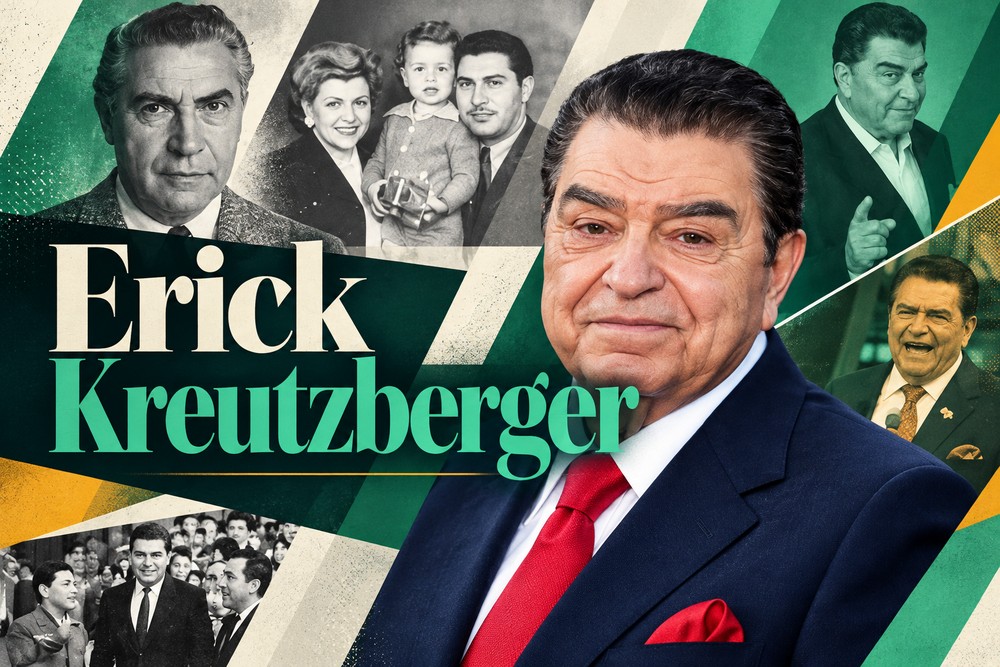
The Night the Telethon Launch Waited
The call reached Miami on a Sunday. Mario Kreutzberger, still hosting Sábado Gigante after more than three decades, flew to Santiago and went straight to his father. Erick Kreutzberger died that night, Sunday 16 April 2000, at 96, after years of Alzheimer’s disease. The launch of Teletón 2000 was hours away. It was postponed.
I keep returning to a smaller scene. Mario said that when his father was 94 and the disease had taken most of him, he found the old man watching Sábado Gigante and asked who the host was. “Don Francisco,” his father said. Not Mario. The name on the screen had outlived the son in the father’s memory.
Everything I know of him arrives through that door: the son, the cameras, the retelling. He never spoke publicly. He left no writing.
One Man Two Names and a Birth Year That Will Not Sit Still
His name is not stable. English language accounts spell him Erick. Spanish ones, German and Polish family trees, and his son’s telling use Erich. I use Erick because that is how he reached the English speaking world.
The birth date is as slippery. The most precise figure is 2 April 1905, in Ligota Woźnicka, the Polish name for Ellguth-Woischnik, then Prussian Silesia and now Poland. Descendants give the same date. A man born that day was 95 on 16 April 2000. The age given at his death was 96. If 96 is exact, he was born in 1904. One of those numbers is wrong and I cannot tell you which.
His parents are worse. One tree names Max Kreutzberger and Lotte Fritlerder. A Polish local history names his mother as Charlotte and leaves the father out. Same woman in two versions, or two claims. No sibling of his has ever been established.
A Wedding in Breslau and a Shop in Neisse
On 12 August 1937, in Breslau, he married Anni Blumenfeld. That date holds steady wherever I look, the firmest prewar fact in his life. They settled in Neisse, now Nysa, where he ran a small clothing firm.
The traces are tiny and specific. In 1935 his business was listed in Nysa at Umflut 10 and again at Zollstraße 7. A surviving garment label reads “Erich Kreutzberger, Neisse, Zollstr. 8.” Three addresses for one small firm, a man shifting his stock from room to room as the decade closed.
One tree gives a marriage in Ñuñoa, in Santiago, on 22 November 1956. That cannot be the start of anything. The sons were born in the 1940s.
Kristallnacht and the Number 27170
The night of 9 and 10 November 1938 found them in Neisse. Both were victims of the violence there. The next day police summoned Erick and an uncle and sent them east to Buchenwald, where he was one of roughly 30,000 Jewish men detained that season and registered as prisoner 27170. He was released in December and moved on to England.
One version puts his entry on 9 December 1938, which sits badly with an arrest the morning after Kristallnacht. An arrest in November and a release in December leave him weeks inside the wire, though one 2012 account said several months. The number has never been confirmed independently, so it stands as the family’s number rather than the camp’s.
Then there is Majdanek, the camp he was said to have survived and never did. For fifty years Mario told audiences his father had been held there, and in 2005 he made a filmed tribute built on it. Majdanek was not built until 1941. Both parents were in Chile by then, and Mario had been born. In 2021 Mario corrected it publicly and later conceded he had named the wrong camp.
About 56,000 people died there, not the 250,000 the family story once carried.
Two Ships and a Reunion at the Dock
The escape was two journeys, and the versions disagree on the calendar while agreeing on the shape.
Anni went first. One version has her sailing from Genoa in June 1939 with her family. Another puts her on the Virgilio in October 1939, reaching Valparaíso on 20 October, waiting on the dock for a husband still in England. Erick crossed later, from Liverpool on 19 December 1939, aboard the Orduña, arriving 18 January 1940. Other tellings have him in Santiago in December 1939, before that ship could have landed.
He passed through England and is placed in Sandwich, Kent, in 1939, near the camp at Richborough that held Jewish men released after Kristallnacht. He is also said to have enlisted in the army there. Nothing supports that and I do not believe it. He was saving for a passage. One account calls him an unsuccessful boxer; his son remembers only being handed gloves briefly as a boy.
Chile under Pedro Aguirre Cerda took in refugees and pushed many out of the capital. The family was sent to Talca, about 250 kilometers south of Santiago, with no Jewish community waiting.
El Chilenito or La Americana
Two shops in Talca, or one shop with two names. One version has him opening El Chilenito with a partner, then moving to Santiago five years later and opening American Tex. The other has the Talca shop called La Americana, continued in the capital as Kreutzberger, later becoming Croston Clothes.
The method matters more than the sign. He learned cutting on his own. He cut suits, had them sewn, and sold them door to door. Then he rented an office, hired two cutters, and put his teenage son to work unrolling cloth and carrying samples around the country. The shop became a factory, and Mario became his partner before leaving for television.
I looked for a number and found none. A refugee with a trade and no capital rebuilt a clothing business twice, in two cities, and paid other people’s wages. He held no office, no academic post, no decoration.
Mario and René and a House That Spoke German
Mario Luis was born in the Talca hospital on 28 December 1940. A second son, René, followed, though no birth date for him appears anywhere, and one tree lists him as dead with no date at all. The names were chosen for assimilation, ordinary Spanish names for boys who would grow up Chilean. German was spoken at home and was Mario’s first language; he learned Spanish at school. Both boys had bar mitzvahs, and the family kept Shabbat.
The father was careful with religion in a way his son later read as damage. He did not push Judaism hard, because of Germany, and he refused to pass on hatred. The household rule was “Nunca te metas en política,” never get into politics. Asked in 1968 about a first trip to Germany, he said: “Perdonar siempre, olvidar nunca.” Always forgive, never forget.
He wanted Mario in the trade and sent him to New York at about 16 to study tailoring. The boy came back wanting television. Sábado Gigante began in 1962, and his father lived long enough to watch it, and to stop recognizing the man inside it.
The Family in One Glance
| Person | Relation to Erick | Settled | Not settled |
|---|---|---|---|
| Anni Blumenfeld Neufeld | wife | married Breslau 12 August 1937, died 1974 | birthplace Breslau or Rawicz, birth year 1913 or 1915 |
| Mario Luis Kreutzberger Blumenfeld | elder son | born Talca 28 December 1940 | nothing material |
| Teresa Muchnick Rosenblum | daughter in law | married Mario, three children named publicly | wedding year 1962 or 1963 |
| René Kreutzberger | younger son | named as Mario’s brother in public tributes | birth date, death date, most of his life |
| Vivi Kreutzberger Muchnick | granddaughter | born Santiago 28 August 1965, television presenter | nothing material |
| Patricio and Francisco Kreutzberger | grandsons | named in family lists | birth years |
| Nicole Numhauser Kreutzberger | great granddaughter | married Stephanie Bruce Maxwell in Chile on 3 December 2022 | birth year, usually given as about 1993 |
A fourth child of Mario’s has been claimed and is not established. The names above are the ones that hold.
The Last Thirty Years and the Gaps Around Them
Around 1970, at the start of the Unidad Popular government, he and Anni decided to return to Germany. Whether they settled there is unclear. He died in Santiago, so any return was partial. She died in 1974. The only week Sábado Gigante missed in its long run was the week she died.
In early September 1999 he had one of his worst crises and was admitted to a private clinic in Santiago. His grave is somewhere in or near Santiago.
I think about the silence most. A man survives Buchenwald, crosses an ocean, opens a shop, raises two Chilean sons, and never says the name of the camp to them. His son then spends fifty years naming the wrong one, and his seventies correcting himself in public. That is what a withheld past does. It does not stay buried. It comes up wrong, and someone has to go back and dig.
Three generations after a village in Prussian Silesia, his great granddaughter Nicole married Stephanie Bruce Maxwell in Chile on 3 December 2022. Mario was in the room. There is only the line of people.
FAQ
Was Erick Kreutzberger a survivor of the camps?
Yes. He was arrested in Neisse after Kristallnacht in November 1938, held at Buchenwald as prisoner 27170, and released that December. The Majdanek story cannot be right, and his son withdrew it in 2021.
Where and when was he born?
The best answer is 2 April 1905 in Ligota Woźnicka, then Prussian Silesia and now Poland. A man born that day was 95 when he died in April 2000, and his age at death was given as 96, which would put his birth in 1904.
What did he do for a living in Chile?
He was a tailor and clothing merchant. He opened a shop in Talca, moved to Santiago around 1945, and built a small factory with cutters on the payroll. The two versions of the story disagree on the shop names, so I give both.
How many children did he have?
Two sons, Mario and René. Mario, born 28 December 1940, became Don Francisco. René appears in family lists, but his dates are not published, and a claim to another son has never been established.
When did he die?
On the night of Sunday 16 April 2000, in Santiago, after a long illness of old age that included Alzheimer’s disease. Mario had landed hours earlier for the launch of Teletón 2000, was with him at the end, and the launch was postponed.